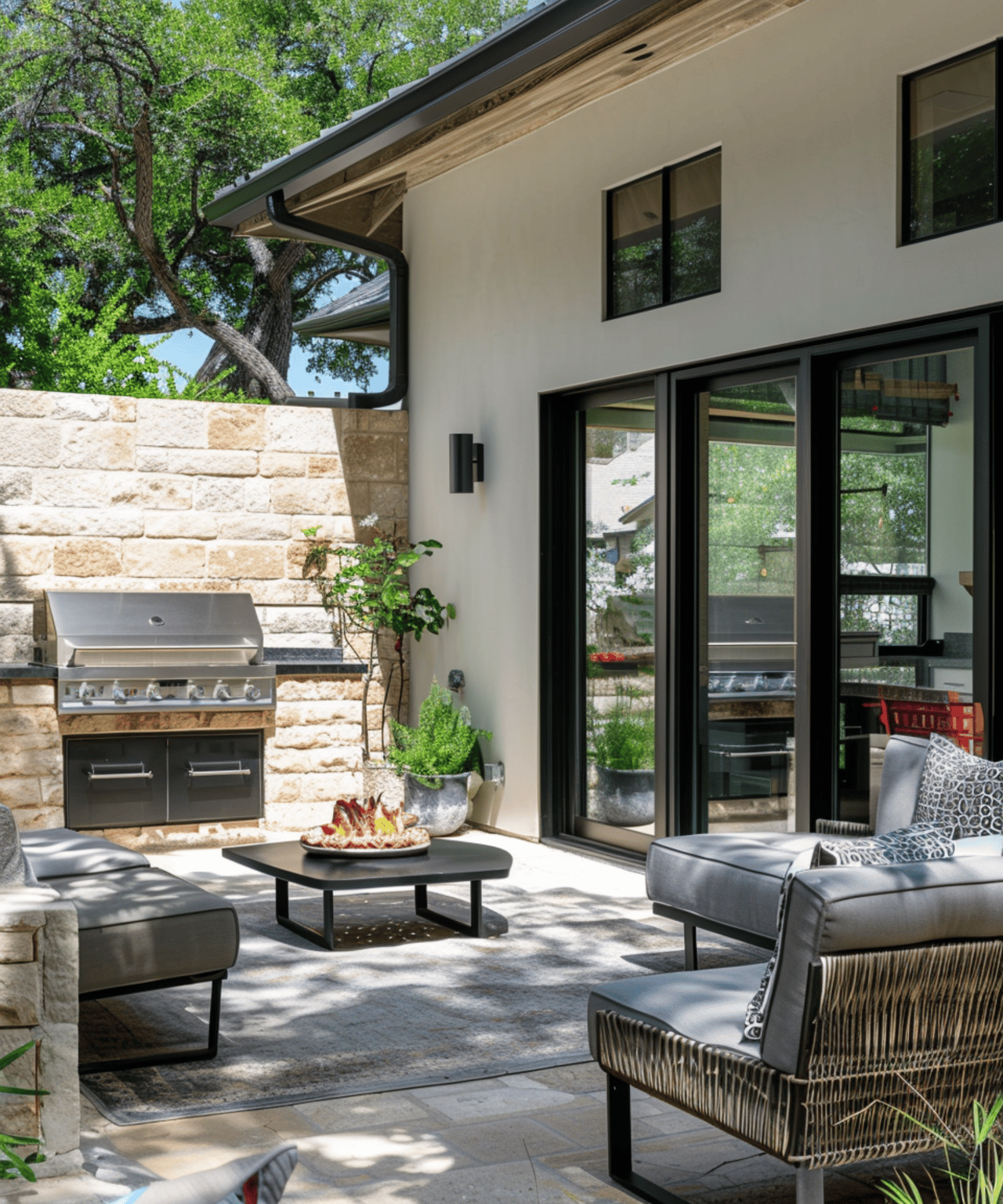
Drive down Ralph Ablanedo Drive near Slaughter Lane on a weekday evening and the first thing you notice is the wall. It rises 48 feet over a stretch of South Austin that used to be mostly warehouse lots, part of a 27,000-square-foot building that opened its doors on May 5, 2026. Climbers are working routes near the top. Below them, an outdoor plaza is filling in with people who never touched a hold: a couple sharing tacos, a laptop open at a coffee table, a dog waiting under a chair. Nobody in that plaza needed a reservation. They needed a parking spot.
That building is Crux Climbing Center's rebuilt South Austin location, and it is not, strictly speaking, a place to eat or drink. But it has one built in anyway. Switchback Coffee & Beer runs the plaza from morning coffee through evening pours, and Granny's Tacos, already a fixture on East 7th Street, serves a full menu on-site. Neither business is the reason the building exists. Both are why people stay once they arrive.
That distinction is the story. South Austin's restaurant scene keeps growing the way it always has, one storefront at a time. But the single biggest addition to the neighborhood's social calendar this year didn't open as a restaurant at all. It opened as a climbing gym with its own coffee-and-beer bar and taco counter.
The gym that bought its own building
Crux's South Austin story did not start smoothly. The gym's original South Austin location on Pickle Road closed at the end of 2024 when its lease ended and Crux chose not to sign another 10-year term. Austin Bouldering Project, which the landlord approached, was slated to take over the space, and the announcement drew a strong response from Austin's climbing community. Crux spent the better part of a year rebuilding, this time about five miles further south on a 4-acre property near Southpark Meadows.
The difference this time is ownership. Crux's earlier locations were leased. The Ralph Ablanedo Drive building is one the gym owns outright, which changes the calculus on everything from the height of the walls to whether it makes sense to run a coffee bar on-site rather than hand that square footage to a separate tenant. Those walls stand nearly 20 feet taller than the gym's original South Austin location, and the facility adds a wellness space for physical therapy and recovery, upstairs work pods, and a dedicated kids' area that the old Pickle Road site never had room for.
In KXAN's report, Crux co-founder Kevin Goradia described the new location as a reflection of "everything we've learned and where we're headed next." In CultureMap Austin's report, co-founder Grace Nicholas, who also owns Switchback, put it in terms of what members actually do between sets: the gym "wanted a space where people could gather, work and unwind, before or after time in the gym."
A coffee bar that runs on gym hours, not bar hours
Switchback is a Crux family project, founded by Nicholas and her husband, Ethan Wagner. It serves coffee, craft beer, wine, and low-ABV cocktails, and it keeps hours that track the gym rather than the neighborhood's nightlife calendar: roughly 7 a.m. to 10 p.m. on weekdays and 8 a.m. to 10 p.m. on weekends. Local coverage has described it as a Far South Austin arrival built for exactly that daytime-to-evening handoff, a coffee counter in the morning that turns into a beer garden by early evening without ever staying open past a gym-appropriate bedtime.
That schedule is a tell. Switchback isn't trying to pull South Austin's Friday-night bar crowd away from anywhere. In CultureMap Austin's report, Nicholas described it as "a local watering hole you circle back to time and again," which is a different pitch than "come out tonight." It's built for the fifteen minutes before or after a climbing session, or for someone who never plans to climb at all but wants a coffee at a table with a view of the wall. Granny's Tacos, which already runs a brick-and-mortar on East 7th Street and a food truck around town, fills the same role for anyone who wants a full meal without leaving the plaza.
Meanwhile, the restaurants keep arriving the old way
None of this means South Austin's dining scene has slowed down. It just means the newest restaurants are entering the neighborhood the way restaurants always have: one storefront, one menu, no climbing wall attached.
Little Nishi, a sushi and handroll concept that has operated out of Teddy's and a former spot on South Congress, is opening its first true brick-and-mortar at 2000 Southern Oaks Dr., off Menchaca Road. And Kiin di, a Thai kitchen that built its following as a food truck, has opened its own storefront in South Austin, drawing comparisons to the kind of Thai food more commonly found in cities like Los Angeles.
Both are straightforward additions. Neither comes with a coffee bar, a taco counter, or a gym membership attached. That's not a knock on either one. It's the contrast that makes Crux's approach stand out: most operators moving into South Austin this year are still betting on one thing done well, while Crux bet on three things under one roof from day one.
What this changes about a Tuesday night
The practical effect shows up in what counts as a plan on a random weeknight. Before, the choice near Southpark Meadows was mostly restaurants, the gym, or staying home, each one a separate errand. Now a resident can climb for an hour, grab a Switchback coffee or beer without leaving the property, and pick up tacos from Granny's on the way to the car. None of that requires a climbing membership to enjoy. The plaza is built to be a stop on its own, the same way a coffee shop with a patio would be, except this one happens to sit at the base of a 48-foot wall.
Whether other operators follow Crux's lead and start building food and drink into new gyms, studios, or retail spaces from the ground up is not yet clear. What is clear is that the model exists now in South Austin, tested and open, and it's pulling some of the neighborhood's evening traffic toward a building that was never advertised as a place to eat.
If you're weighing a move to South Austin, or you already call it home and want a read on how additions like this touch property values nearby, Victor Barrios is happy to talk through what's changing block by block.